
Offside means an attacking player is nearer the opponents' goal line than both the ball and the second-last defender at the exact moment a teammate plays the ball, and that player then gets involved in the play. That's the whole rule in one sentence. Everything else, the VAR reviews, the freeze-frame lines, the confused groans from the stands, is just detail layered on top of that single idea.
Being caught in that spot isn't automatically a foul. IFAB's Law 11 is clear that an offside position only becomes an offside offense once the player touches the ball, disrupts an opponent, or gains an advantage from it. A striker can stand two yards behind the last defender all game long and never be flagged, as long as nobody plays a ball to him while he's there.
Here's how to check it yourself, live, without waiting for a pundit to explain it:
- Half check: Is the attacker standing in the opponents' half of the field?
- Position check: At the moment the pass is struck, is the attacker ahead of both the ball and the second-last opponent (usually the last outfield defender)?
- Involvement check: Does the attacker then touch the ball, get in a defender's way, or benefit from a deflection?
If the answer to all three is yes, that's offside. If any one of them is no, play stands. Two authorities govern how this gets enforced on the pitch: IFAB writes the Laws of the Game, and video assistant referees, increasingly backed by semi-automated offside technology (SAOT), help confirm marginal calls. When the flag goes up correctly, the sanction is an indirect free kick for the defending team from the spot of the offense.
Key Takeaways
Offside requires three things at once: an attacker ahead of the ball and the second-last defender in the opponents' half, judged at the exact moment of the pass, followed by active involvement in play.
| Point | Details |
|---|---|
| One sentence definition | An attacker beyond the ball and the second-last defender at the pass moment, then involved in play. |
| Position isn't the offense | Standing offside is legal; the offense needs a touch, interference, or advantage gained. |
| Timing is everything | Officials judge the moment the ball is played, not when it's received. |
| Three exemptions exist | Goal kicks, throw-ins, and corners never produce an offside offense. |
| Technology aids, doesn't replace | SAOT speeds up spatial checks, but "interfering with an opponent" stays a human judgment call. |
Table of Contents
- What Does Offside Position Actually Mean?
- When Does an Offside Position Become an Offside Offense?
- What Situations Are Exempt From the Offside Rule?
- How Do Referees Signal and Enforce Offside?
- How Does VAR Actually Check an Offside Call?
- Which Game Situations Confuse New Fans Most?
- Why Has the Offside Law Changed Over Time?
- How Can You Explain Offside to a Friend in One Minute?
- Why We Explain It This Way
- Frequently Asked Questions
- Sources
What Does Offside Position Actually Mean?
The formal test has two parts, and both have to be true at the same instant. First, the attacking player has to be standing in the opponents' half of the field, not their own. Second, they need to be closer to the opponents' goal line than both the ball itself and the second-last opponent, which in practice is usually the last outfield defender since the goalkeeper is typically the very last one back.
Picture a flat line running across the pitch at the level of that second-last defender. Anyone from the attacking team standing beyond that line, closer to the goal, and also ahead of the ball, is in an offside position. A designer sketching this out would draw two vertical lines cutting across the width of the field: one through the ball, one through the second-last defender, with the attacker's position marked relative to both.
Not every body part counts the same way. IFAB's Law 11 specifies that a player's head, body, and feet all count toward the offside line because those are the parts that can legally play the ball. Hands and arms don't count at all. The dividing line used in practice is the bottom of the armpit. If a striker's arm is stretched out ahead of the defensive line but his shoulder and chest are level, he's onside, because an arm can't score a goal.
Timing matters just as much as positioning. Offside is judged at the exact moment a teammate plays the ball, not when the ball actually arrives at the attacker's feet. Research on offside interpretation confirms this is the moment officials freeze on: the instant of the pass, not the reception. This trips up a lot of new fans watching a counterattack unfold.
- The relevant moment is when the ball leaves the passer's foot, head, or chest.
- A player can be level with the last defender at that instant and then sprint ahead of the line as the ball travels. That's completely legal.
- A player can also be behind the line at the moment of the pass, then run forward into space. Also legal, because the offside check already happened.
This single detail, judging the freeze-frame at the pass rather than the catch, is exactly why SAOT cameras lock onto the passer's foot contact rather than tracking the whole run.
When Does an Offside Position Become an Offside Offense?
Standing offside isn't a crime by itself. The offense only exists once a player in that position gets involved in what IFAB calls "active play." There are three separate ways this happens, and each one covers a different kind of interference.
Interfering with play is the most straightforward version: the player in the offside position touches the ball. A striker ghosting in behind the back line, receiving a through ball, and slotting it past the keeper is the textbook case. No ambiguity there. The flag goes up, the goal is chalked off.

Interfering with an opponent is murkier, and it's where most confusion for new fans comes from. This covers a player who never touches the ball but still affects the game by blocking a defender's run, challenging for the ball, or, most commonly, obstructing the goalkeeper's line of sight. Sporting News points out that a forward standing directly in front of a keeper as a shot comes in can be flagged offside purely for blocking the view, even if he never gets near the ball. Picture a striker loitering right in the six-yard box while a teammate curls in a shot from 20 yards out. If that striker is standing between the keeper and the ball when it's struck, officials can rule he obstructed the save attempt, even though his foot never touched anything.
Gaining an advantage covers the rebound scenario. If a shot cannons off the post or the goalkeeper makes a save and the ball falls to a player who was in an offside position when the original shot was taken, that follow-up goal doesn't count. The logic is straightforward: that player only got the chance to score because of where he was standing when the first ball was played.
Here's why the "interfering with an opponent" test creates arguments in every pub and living room during a big match: it depends on the referee's read of intent and impact, not a clean physical fact like a touch on the ball. Two officials can watch the same replay and disagree on whether a striker's presence "genuinely" blocked a defender's attempt to play the ball versus just standing nearby without affecting anything. Analysts note) that this subjectivity exists by design. The law is built to stop "goal hanging," a striker parking near the six-yard box waiting for scraps, while still allowing legitimate attacking runs that happen to end up near an offside player who stays out of the action.
Pro Tip: Broadcast graphics love to draw a clean red or green line across the pitch, but that line is generated after the fact from camera data. The assistant referee on the touchline has none of that. He's tracking a moving line with his own eyes from 40 yards away, in real time, which is exactly why marginal calls get missed live and corrected later on review.
What Situations Are Exempt From the Offside Rule?
Three restart situations are exempt from offside entirely, and knowing them stops you from shouting at the screen over a non-call that was never a foul to begin with.
- Goal kicks: A player can be standing miles offside and still legally receive the ball straight from a goal kick. IFAB's Law 11 and standard match rules both confirm there's no offside offense on a goal kick, full stop.
- Throw-ins: Same exemption applies. A forward can be camped behind the last defender and still legally collect a long throw.
- Corner kicks: Also exempt. A striker lurking at the near post when a corner comes in is never offside off that delivery, no matter how far forward he's positioned.
There's a real reason for these three carve outs. Restarts like these are already tightly controlled, defenses know exactly when and where the ball is coming from, so the offside law doesn't need to police them the way it polices open play.
One more distinction trips people up: deliberate play versus a deflection. If a defender deliberately controls the ball, that resets the offside calculation for anyone tracking a rebound. But a deflection off a defender who was simply trying to block a shot or clear a dangerous ball doesn't reset anything, because that contact wasn't a controlled, deliberate act. A goalkeeper's save is treated the same way as a deflection rather than a deliberate pass, which is exactly why a rebound goal after a save can still be ruled offside against the original position.
How Do Referees Signal and Enforce Offside?
The call starts with the assistant referee running the touchline, tracking the last defender and the ball almost simultaneously. When he judges an attacker offside at the moment of the pass, he raises his flag straight up, then usually holds it at an angle to indicate which side of the field the infraction happened on: left, right, or center.
That flag is a signal, not a final verdict. The center referee has final authority and can, in rare cases, wave play on if he believes the assistant made an error, though in practice referees trust their assistants' calls the vast majority of the time since the assistant has a better lateral view of the defensive line. Where VAR is active, a flagged offside that led to a goal being disallowed, or a goal that was allowed despite a marginal offside look, both get a second check.
The sanction for a confirmed offside offense is an indirect free kick awarded to the defending team, taken from the spot where the offside player became involved in play, not from where the ball was originally passed. That distinction matters tactically. An offside call deep in the attacking third hands the defense a free kick right at the edge of their own box, which is a minor inconvenience. But an offside called near the halfway line gives the defense a restart in a much safer zone, effectively killing the attacking move stone dead.
- Flag straight up: offside offense signaled, referee to confirm.
- Flag at an angle (left, center, right): indicates the zone of the pitch where the offense occurred.
- No flag, play continues: assistant judged the attacker onside or not yet involved in play.
Human sightlines have real limits here. An assistant referee has to watch two moving lines at once, the ball and the last defender, from a fixed spot on the touchline, often 30 or 40 yards from the action. Anyone curious about how officials train for exactly this kind of split-second judgment call can dig deeper on Football Planet's referee resources.
How Does VAR Actually Check an Offside Call?
Video assistant referees step in on offside decisions in a narrower set of circumstances than most fans assume: primarily on goals, and on clear and obvious errors that directly affect a goal-scoring chance. ESPN's breakdown of offside law confirms VAR isn't reviewing every marginal call in open play, only the ones tied to a goal being scored or a clear scoring opportunity being wrongly denied.
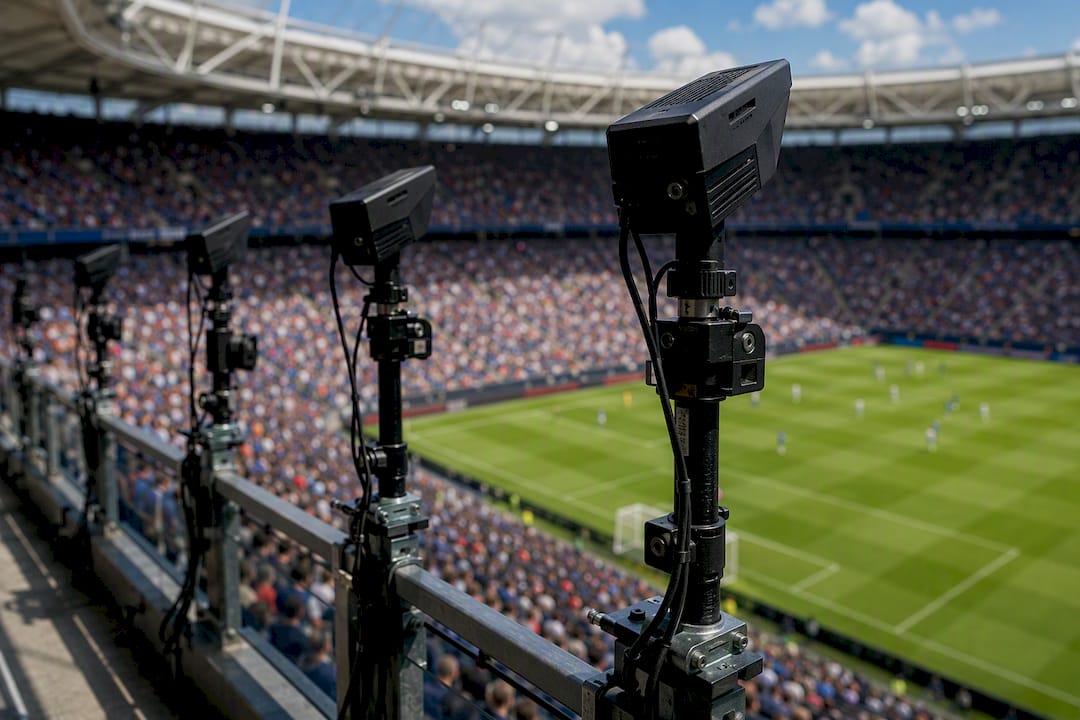
Semi-automated offside technology has changed how fast that review happens. SAOT uses a network of tracking cameras positioned around the stadium roof, combined with sensor data from the match ball itself, to plot the exact position of every player's relevant body parts at the precise moment the ball is played. The system generates a 3D offside line almost instantly instead of the old method of a human operator manually drawing lines across a 2D broadcast image, enhancing the speed and accuracy of calls.
That speed doesn't eliminate judgment calls entirely, though. ESPN's coverage notes that SAOT reduces human error on the purely spatial question (where exactly was the armpit, the heel, the shoulder) but the decision about whether a player was actively involved in play, interfering with an opponent, blocking a sightline, still rests with human officials watching the replay. Technology answers "where," not "did it matter."
Marginal calls still spark arguments even with automated lines, for a few concrete reasons. Camera calibration has to be precise across every angle in the stadium, and any drift introduces error. The exact frame selected as "the moment of the pass" can shift the result by inches if the passer's foot is mid swing. And there's ongoing debate in football media about which body part should actually define the line, since a toenail ahead of the last defender produces the same red line as a full stride offside, even though they look nothing alike to the eye. Competitions using this technology most consistently include major international tournaments, which Football Planet tracks through its international competitions hub.
Pro Tip: When a broadcast shows a marginal offside under VAR review, watch for which frame they freeze on. If the graphic locks onto the passer's foot at the exact moment of contact, that's the correct legal test. If it freezes a split second later, once the ball has already traveled, that replay is technically showing you the wrong moment, even if the line looks dramatic.
Which Game Situations Confuse New Fans Most?
Three situations get called onside constantly, and confused fans assume a mistake was made every time.
- A striker receiving a corner kick while standing ahead of the last defender. No offside exists on corners at all, so this is always legal no matter how far forward the striker is positioned.
- A defender deliberately heading the ball to a teammate, who then plays it to a forward who was previously offside. That deliberate touch resets the offside calculation entirely. The forward is now judged fresh from that new pass.
- An attacker level, not ahead, of the second-last defender when the ball is played. Level counts as onside under the law. Being exactly even with the last defender's shoulder is legal; only being clearly ahead triggers the flag.
Three situations get flagged constantly too, and they're worth memorizing because they follow the exact same pattern every time.
- A striker timing a run perfectly, staying level until the pass is struck, then breaking in behind. If he was already a step ahead of the defender at the moment of the pass rather than level, that's offside, even if the run itself looks identical to a legal one from the stands.
- A forward standing in an offside spot who never touches the ball but screens the goalkeeper as a teammate shoots from distance. The block on the keeper's vision is enough to trigger the flag under the interference-with-an-opponent test.
- A player pouncing on a rebound after his own shot is saved, having been offside when the original shot was struck. The rebound doesn't erase the earlier offside position; it just delays the whistle.
Two quick mental pictures help this stick. Think of the last defender as the edge of a campsite, and the offside line as the tent's boundary rope. A player camping just outside that rope, waiting for the ball to be lobbed over, is exactly the "goal hanging" the law was built to stop. Second image: think of the pass moment like a photograph, not a video. Whatever position the attacker is in when that photograph is snapped is the only position that counts, no matter what happens in the frames after it.
Run this five-second checklist next time a through ball splits the defense: half check, position check, involvement check. If all three land yes, you'll have called it before the flag even goes up.
Why Has the Offside Law Changed Over Time?
The offside law traces back to football's earliest codified rules in the 1800s, when the original version required three defenders (not two) between the attacker and the goal, a far more restrictive standard than today's rule. That got reduced to two defenders, the current standard, in 1925, specifically to open up attacking play after goal-scoring had dried up under the stricter version.
A more recent tweak addressed the "level" question directly: a player exactly level with the second-last defender is now explicitly onside rather than offside, a change aimed at giving attackers the benefit of the doubt on tight calls rather than punishing marginal positioning. That shift, combined with the rollout of VAR and SAOT, reflects a consistent trend in how IFAB has managed the law: nudge the balance toward attacking football whenever the data suggests the game has grown too cautious.
This history explains a lot of modern tactics. The offside trap, where a defensive line steps forward in unison right as the ball is played to catch an attacker out of position, exists entirely because of this law. Teams that play an aggressively high defensive line are betting that their timing will beat the forward's run more often than not. Every fullback push forward, every winger's diagonal run timed to the split second, traces back to this single law shaping how both halves of the pitch behave. For the full historic wording and every amendment, IFAB's official Laws of the Game remain the definitive source.
How Can You Explain Offside to a Friend in One Minute?
Here's a script you can say out loud, start to finish, in about sixty seconds: "Offside means an attacker is standing closer to the goal than both the ball and the second-to-last defender when a teammate passes it to him. Just standing there isn't illegal. It only becomes a foul if he then touches the ball, gets in a defender's way, or benefits from a deflection. Picture a striker sneaking in behind the last defender to receive a through ball. The moment that pass leaves his teammate's foot is the only moment that counts. If he's ahead of the line right then, it's offside, even if he was level a second earlier."
A simple visual trick works better than words for a lot of people. Pause the broadcast on your phone right as the pass is struck, then draw an imaginary line straight across the screen at the last defender's feet. Anyone from the attacking team standing above that line, closer to the goal, is offside at that instant.
A few dos and don'ts make the lesson stick:
- Do use a real clip from a match you're both watching rather than a hypothetical description.
- Do keep the explanation to the three checks: half, position, involvement.
- Don't bring up VAR, SAOT, or camera calibration on a first pass. That's advanced material that only confuses the core idea.
- Don't use phrases like "second-last opponent" with a total beginner. Just say "the last defender" and simplify.
Why We Explain It This Way
Most explainers bury the definition under legal language borrowed straight from the Laws of the Game, which is exactly backward for a beginner. We led with the one-sentence answer and the three checks because that's what actually helps you call it correctly during a live match, not what helps you win a rules debate in a forum. The exceptions, the history, the VAR mechanics all matter, but only after the core test is solid in your head.
Try the three-check method in the very next match you watch. Half, position, involvement. Football Planet's live scores hub is a good place to practice against real matches as they happen, and you'll be surprised how fast it becomes automatic.
Want to put this knowledge to work? Football Planet gives you the tools to follow every marginal call as it happens, not just read about it afterward. Track live matches, watch how assistant referees and VAR interact in real time, and dig into referee decisions through our dedicated referee content hub. Once the rule clicks, testing your eye against real games gets a lot more fun, especially when you can back your predictions with FP Predictor and earn FP Points for calls you get right. Your football day starts here.
Frequently Asked Questions
What is the offside rule in the simplest terms? An attacker is offside if they're standing closer to the opponents' goal than both the ball and the second-last defender at the moment a teammate passes it, and they then get involved in the play.
What is stoppage time, and is it related to offside? Stoppage time, also called injury time, is extra time added at the end of each half to make up for delays like injuries, substitutions, or time wasted on goal celebrations. It's unrelated to offside; the two are separate concepts that just happen to come up in the same broadcasts.
How is stoppage time calculated? The fourth official tracks delays throughout each half, including substitutions, medical stoppages, and VAR reviews, then the referee adds an announced minimum to the end of the half, though the actual added time can run longer if new stoppages occur during it.
Is injury time the same as stoppage time? Yes, they're the same thing. "Injury time" is the older, more informal term, while "stoppage time" and "added time" are the terms used more consistently in modern broadcasts and official language.
Can a player be offside from a throw-in? No. IFAB's Law 11 and standard match rules both confirm offside doesn't apply on throw-ins, so a player can legally receive the ball in an offside position directly from one.
Does being offside always result in a stopped play? Only if the referee or VAR confirms the offense. Being in an offside position without touching the ball or interfering with an opponent means play simply continues with no whistle at all.
What's the punishment for an offside offense? The defending team receives an indirect free kick, taken from the spot where the offside player became involved in play rather than from where the original pass started.
Sources
Start with IFAB's Law 11, the primary authority for the exact legal wording, every exemption, and the armpit boundary rule. For a broadcast-friendly walkthrough with real match examples, ESPN's offside explainer covers how VAR and SAOT actually work during a live tournament. Sporting News breaks down the subjective "interfering with an opponent" test with clear, concrete scenarios. And the Wikipedia entry on offside is a solid quick reference if you want the law's history and diagrams in one place.
- Law 11 - Offside | IFAB
- PMC article on offside timing and interpretation
- How does offside work in soccer? Explaining one of the sport's key laws - ESPN
- Offside rule in soccer, explained | Sporting News