
Six strategies separate top FP Points earners from everyone else guessing on gut feeling: xG-first analysis, form-plus-lineup checks, contrarian high-variance picks, consensus-leaning safety plays, confidence-management, and scheduled league specialization. Each one maps directly to a Football Planet tool you already have open.
- xG-first: Check the Expected Goals (xG) page before trusting a scoreline.
- Form + lineup: Confirm the starting eleven before locking a pick in FP Predictor.
- Contrarian high-variance: Fade the popular pick on one match per week for bonus FP Points swings.
- Consensus-leaning: Follow the crowd on low-confidence fixtures to protect your streak.
- Confidence management: Save your highest confidence stakes for your most-researched leagues.
- Scheduled specialization: Pick two or three competitions and track them weekly instead of chasing every fixture.
Key Takeaways
Consistent match prediction success comes from combining transparent data signals like xG and confirmed lineups with disciplined confidence allocation and regular tracking of your results.
| Point | Details |
|---|---|
| Prioritize transparent signals | Lean on xG, rolling form, and confirmed lineups over opaque inputs like betting odds. |
| Time your workflow | Check form early, confirm lineups 60 to 90 minutes before kickoff, then submit your pick. |
| Split confidence deliberately | Aim for mostly steady picks and some contrarian swings, adjusting as the season progresses. |
| Track calibration, not just wins | Log picks with date, confidence, and outcome, and review every two to three weeks. |
| Use Football Planet's built-in tools | FP Predictor, the xG page, and live updates cover the entire workflow from research to submission. |
Table of Contents
- Six Match Prediction Strategies Worth Learning
- Which Pre-Match Data Signals Actually Move the Needle?
- How Do You Build a Pre-Match Prediction Workflow?
- How Should You Allocate FP Points Confidence?
- How Do You Track and Improve Your Prediction Accuracy?
- What Mistakes Wreck Most Prediction Records?
- Do Weather, Referees, and Motivation Really Change a Prediction?
- Does One Prediction Strategy Work Across Every League?
- What Ethical Lines Matter in a Free Prediction Game?
- How Much Time Does This Actually Take?
- What Do Machine Learning Models Add to Match Prediction?
- What I've Learned From Predicting Every Matchday
- Put These Strategies to Work Inside Football Planet
- Frequently Asked Questions
- Sources
Six Match Prediction Strategies Worth Learning
Not every strategy fits every fixture, and that is the entire point. The strongest players rotate between tactics depending on how much they know about a match and how much risk they want on the leaderboard that week.
xG-first works best when a team's results have diverged from its underlying performance. A club can win 1-0 while getting outplayed, and Expected Goals catches that gap before the standings table does. Simplicity: low. Data required: xG readings, ideally home/away split. Best use case: steady accuracy over a full season. Pre-match horizon: anytime after both teams have logged four or five matches.
Form plus confirmed lineups is the workhorse strategy. Recent form tells you momentum; lineups tell you whether that momentum survives a rotated squad. Best applied 60 to 90 minutes before kickoff once team sheets drop.
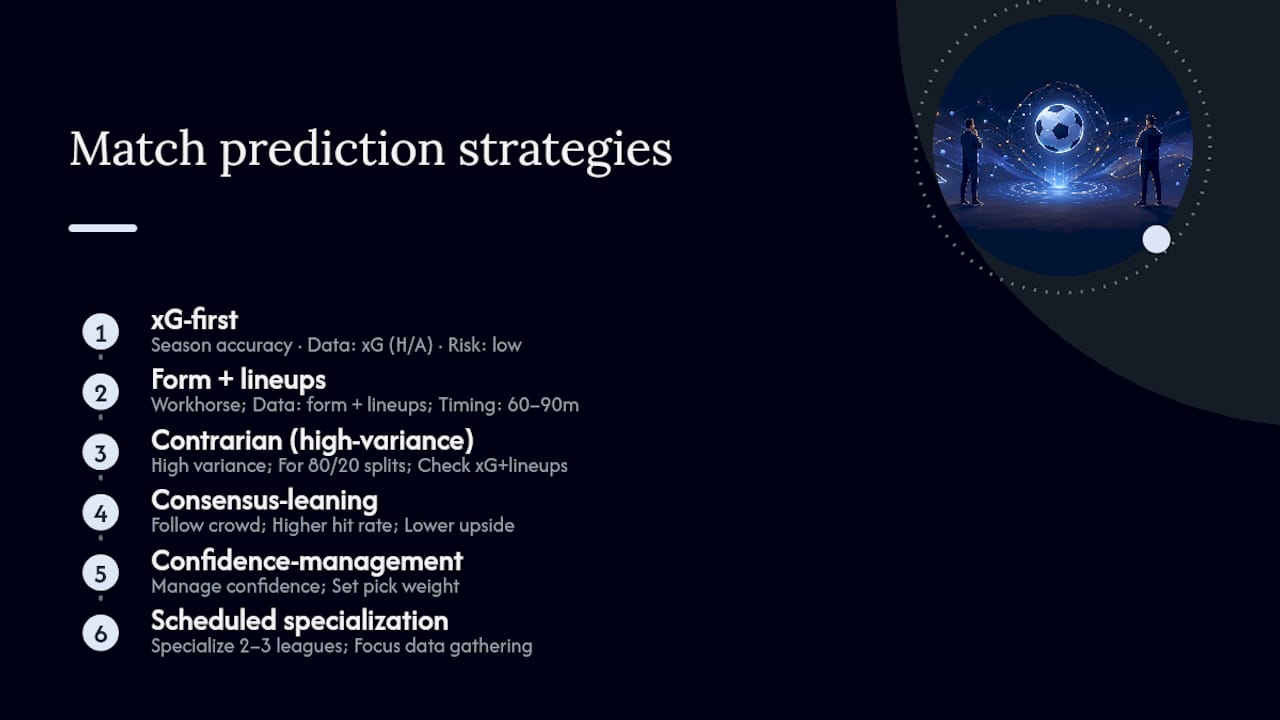
Contrarian high-variance picks reward the fan chasing a fast climb up the leaderboard rather than steady points. If the crowd is split 80/20 on a draw-heavy fixture, siding with the minority carries more upside if it lands. This is a specialization play, not a weekly habit.

Consensus-leaning picks are the opposite: you follow where community sentiment already sits, sacrificing upside for a higher hit rate on matches you have not researched deeply.
Confidence-management is less a prediction method and more a discipline. It decides how much weight a pick gets inside FP Predictor, independent of which team you choose.
Scheduled specialization means narrowing your attention to two or three leagues (the International Football hub or Women's Football coverage, for example) so your data-gathering effort concentrates instead of spreading thin across ten competitions.
Pro Tip: Run contrarian picks only on matches where you have already checked lineups and xG. A contrarian pick made blind is just a coin flip with extra risk attached.
Which Pre-Match Data Signals Actually Move the Needle?
Four signals do most of the work: Expected Goals, rolling form, confirmed lineups, and team ratings.
- Expected Goals (xG) measures shot quality rather than shot outcome, and it stays more stable match to match than scorelines do.
- Rolling form, ideally over a a rolling window of several recent matches, balances recency against noise. Windows shorter than five matches overreact to one bad game; windows longer than seven dilute a team's current shape, according to the Sim2Win tactical profiling framework, which demonstrated strong generalization performance on previously unseen teams.
- Confirmed lineups matter because a rotated squad can flip a fixture's whole calculus in the final hour before kickoff.
- Team ratings, built from player quality and formation data, work as a proxy when you cannot dig into ten matches of history for an unfamiliar side.
An interpretable machine learning model using FIFA-style ratings and formation data posted a respectable F1-score against a betting-odds baseline of 0.39 across several recent seasons of Premier League matches. That gap is the difference between a system built on visible signals and one leaning on market noise alone.
Be careful with anything opaque. Betting odds bake in information you cannot see and shift for reasons that have nothing to do with form. A single wild scoreline from two weeks ago is just as misleading if you treat it as gospel.
How Do You Build a Pre-Match Prediction Workflow?
A repeatable timeline beats a fresh decision process every matchday. Here is one that fits comfortably around a normal week:
- 2 to 3 days out: Shortlist your matches. Two or three fixtures you can actually research beat ten you glance at.
- 6 to 2 hours out: Scan for team news. Check the AI Football Assistant for a quick summary of injuries and suspensions.
- 90 to 60 minutes out: Confirm the official lineup. This single step catches more surprise results than any statistical model.
- 60 to 30 minutes out: Factor in referee tendencies for cards or penalties on the Football Referees page, and check weather if it is severe enough to flatten a passing game.
- Final step: Submit your pick in FP Predictor with a confidence level and a one-line rationale.
Keep the rationale short: pick, confidence, one sentence why. "Draw, medium confidence, both sides missing a starting striker" takes ten seconds to type and saves you from repeating the same mistake next month.
How Should You Allocate FP Points Confidence?
Two play styles dominate leaderboard climbing: steady-accuracy and contrarian-high-payoff. Steady-accuracy compounds small, reliable gains across dozens of picks. Contrarian-high-payoff swings big on a handful of fixtures where you disagree with the crowd.
- Reserve your highest confidence tier for matches where xG, form, and lineups all point the same direction.
- Drop confidence a full tier whenever a lineup is unconfirmed less than an hour before kickoff.
- Increase contrarian allocation late in a leaderboard season if you are chasing rank, since steady points alone rarely close a large gap.
- Never put your top confidence on a match you have not checked lineups for, regardless of how good the fixture "feels."
This mirrors how disciplined tipping-competition players manage the length of a season: consistency over months, not a hot week in October, wins the leaderboard.
How Do You Track and Improve Your Prediction Accuracy?
Track four things: sample size, calibration (predicted confidence versus actual outcome), hit rate broken down by confidence tier, and how your pick compares to where consensus landed by kickoff.
Run a simple experiment: apply one selection rule for 50 picks, a different rule for the next 50, and compare which one calibrates better. A beginner-friendly checklist built around logging predictions is the fastest way to separate a lucky streak from a real edge.
| Date | Fixture | Pick | Confidence | Outcome |
|---|---|---|---|---|
| Mar 1 | Team A vs Team B | Home win | High | Correct |
| Mar | Team C vs Team D | Draw | Medium | Incorrect |
- Review your log every two to three weeks, not after every single match.
- Adjust one variable at a time, whether that is your rolling-form window or how much weight you give lineups.
What Mistakes Wreck Most Prediction Records?
- Recency bias: One big win colors your next three picks. Correct it by checking the full rolling-form window, not just last weekend.
- Overfitting to one stat: Leaning entirely on xG while ignoring lineups. Correct it by requiring at least two aligned signals before high confidence.
- Chasing leaderboard movement: Copying whoever jumped rank this week. Correct it by sticking to your own tracked process.
- Ignoring lineup uncertainty: Submitting before team news drops. Correct it by waiting the extra hour when a squad is unpredictable.
Do Weather, Referees, and Motivation Really Change a Prediction?
They shift probabilities more than most fans assume, but they rarely override strong data on their own. Heavy rain or high winds tend to suppress total goals and favor tighter, more physical matches, so a fixture you had marked as high-scoring based on xG trends deserves a second look if the forecast turns severe.
Referees matter more than casual fans give them credit for. Some officials call significantly more penalties or issue more cards per match than others, which changes the calculus for red-card scenarios or late-game momentum. The Football Referees page is worth a glance for any match where discipline could decide the outcome.
Motivation is harder to quantify but still real. A mid-table club playing its local rival, a team fighting relegation in April, or a side that has already secured its league position by matchday 36 all bring different intensity levels than the raw stats suggest. Treat motivation as a tiebreaker, not a primary signal. It should nudge a pick you are already close to making, not override strong form and xG data pointing the other direction.
The mistake most fans make is overweighting one external factor after it mattered once. A referee who awarded three penalties last month does not automatically award another one this weekend. Treat these factors as adjustments at the margin, applied after your core data check, not as the headline reason for a pick.
Does One Prediction Strategy Work Across Every League?
No single approach transfers cleanly across every competition, and that is worth knowing before you specialize. Leagues with heavy squad rotation, like domestic cup competitions layered on top of a league season, punish anyone relying purely on recent form because the "recent" matches might not reflect the lineup that actually shows up.
Data-rich leagues like the Premier League, La Liga, and Serie A reward xG-first approaches because the underlying stats are deep and well-tracked. Less-covered leagues and most women's competitions demand more manual form-and-lineup checking since granular xG data is thinner. The Women's Football section rewards specialization precisely because fewer casual predictors dig into team news there, which can be an advantage if you put in the work.
International tournaments and national-team fixtures behave differently again. Motivation swings harder (a dead rubber versus a qualifier decider), squads assemble with less match-fitness data, and rolling form from club football barely applies. The International Football hub is a better home for a distinct set of habits than your weekly domestic-league routine.
The practical takeaway: pick a small set of competitions, learn their specific quirks, and resist applying one blanket method everywhere. A tactic tuned for one league's rhythm can actively mislead you in another.
What Ethical Lines Matter in a Free Prediction Game?
Football Planet's prediction game runs on FP Points, not money, and that distinction shapes the ethics of how you should play it. There is no financial harm in a wrong pick, which frees you to experiment, take contrarian swings, and learn from mistakes without real-world stakes attached.
That freedom comes with its own responsibility, though. Sharing predictions with friends or a fan community is part of the fun, but presenting a guess as certainty misleads people who trust your track record. If you are wrong more than you are right on a particular league, say so. Calibration only works as a trust signal if you are honest about it.
Respect the line between analysis and manipulation, too. Spreading unverified injury rumors or exaggerated team news to sway other predictors in a shared league undermines the community aspect that makes gamified prediction fun in the first place. Stick to information you can actually verify through confirmed lineups and published team news.
Finally, keep the game in perspective. FP Points measure engagement and skill at a fun hobby, not your worth as a fan. Treat a losing streak as a data problem to fix, not a personal failure.
How Much Time Does This Actually Take?
Less than most fans assume once the workflow becomes routine. A single well-researched pick, using the full pre-match checklist from lineup confirmation to xG review, takes roughly 10 to 15 minutes once you know where to look.
If you are running two or three specialized leagues, budget 30 to 45 minutes total per matchday round, spread across the days leading up to kickoff rather than crammed into one sitting. The 24-to-6-hour window is where most of that time goes, since that is when form data solidifies and rumors about lineups start circulating.
Casual players who just want to submit a handful of picks a week can trim that dramatically. Checking rolling form and confirmed lineups for two fixtures takes about five minutes each if you already know the teams. The steady-accuracy approach rewards this kind of light, consistent effort far more than the contrarian approach does, since contrarian picks demand deeper research to justify the extra risk.
The real cost is not the time per pick. It is the discipline to log results and review them every few weeks rather than never looking back at old predictions at all.
What Do Machine Learning Models Add to Match Prediction?
Machine learning has quietly improved how prediction systems weigh signals, but the gains come from interpretable features, not black-box magic. The strongest models blend player ratings, formation data, and historical match statistics rather than relying on one input alone.
An XGBoost-based framework using FIFA-style player ratings and formation features outperformed a betting-odds baseline by a meaningful margin across several recent seasons of Premier League data. What makes this useful for app-based prediction is that the underlying features (who is playing, in what formation) are visible to any fan checking confirmed lineups before kickoff.
Separately, a Bayesian dynamic approach with period-specific priors adaptively adjusts to squad and coaching changes, reflecting the reality that a team's strength this month may not match its strength three months ago after a transfer window or manager change. That is the mathematical version of exactly what the "confirmed lineups" step in your workflow is trying to catch by eye.
The practical lesson for app-based predictors is not to build your own model. It is to prefer transparent signals to opaque ones. A system built on visible data like xG and lineups will always be easier to learn from and adjust than one built on a stat you cannot see or verify yourself.
What I've Learned From Predicting Every Matchday
I check confirmed lineups before I lock in a single high-confidence pick, no exceptions. That one habit has saved more of my prediction streaks than any statistical model I have tried. Early on, I chased every fixture on the board and burned through picks without tracking anything, which meant I never actually got better. Now I run two leagues, log every pick with a one-line rationale, and review my calibration every couple of weeks. It is a small habit, but it is the difference between guessing and actually improving.
Put These Strategies to Work Inside Football Planet
Every strategy above already has a home in the app. FP Predictor is where the workflow ends: you check xG, confirm lineups, set your confidence, and submit, all in one place instead of juggling tabs. The Expected Goals page gives you the exact signal that outperformed odds-based baselines in the research above, updated for the matches on your shortlist right now. Live score updates confirm match status and late lineup news in the final hour before kickoff, closing the gap between your pre-match research and what actually happens on the pitch.
If you have been predicting on gut feeling alone, start smaller than you think. Pick two leagues, run the pre-match checklist for one matchday, and log the results. Then head to FP Predictor and submit your next pick with an actual confidence level attached instead of a shrug. Your leaderboard rank will tell you within a few weeks whether the process is working.
Frequently Asked Questions
What are the best match prediction strategies for a free app leaderboard? The six strategies that work most reliably are xG-first analysis, form-plus-lineup checks, contrarian high-variance picks, consensus-leaning safety plays, confidence management, and scheduled league specialization. Most players get the best results mixing steady and contrarian approaches rather than sticking to just one.
How important is Expected Goals (xG) compared to the final score? Very important for short-term forecasting. xG measures shot quality rather than outcome, and it stays more stable match to match than scorelines, which can be skewed by one lucky deflection or a missed penalty.
How often should I check my prediction accuracy? Every two to three weeks, once you have at least 20 to 30 picks logged. Reviewing after every single match makes it hard to spot real patterns versus normal variance.
Should I always follow the crowd's consensus pick? No. Consensus-leaning works well for matches you have not researched deeply, but contrarian picks on matches where you have real data and disagree with the crowd tend to offer better leaderboard upside.
Does weather actually change how I should predict a match? It can, particularly for matches with heavy rain or strong wind, which tend to suppress scoring. It should adjust a pick you are already close to making rather than override strong xG and form data on its own.
Sources
- A framework of interpretable match results prediction in football with FIFA ratings and team formation | PLOS One
- Sim2Win: team-agnostic, event-based pre-match tactical recommendation framework | arXiv
- Football Prediction for Beginners: Stop Guessing — Sports Command (blog)